

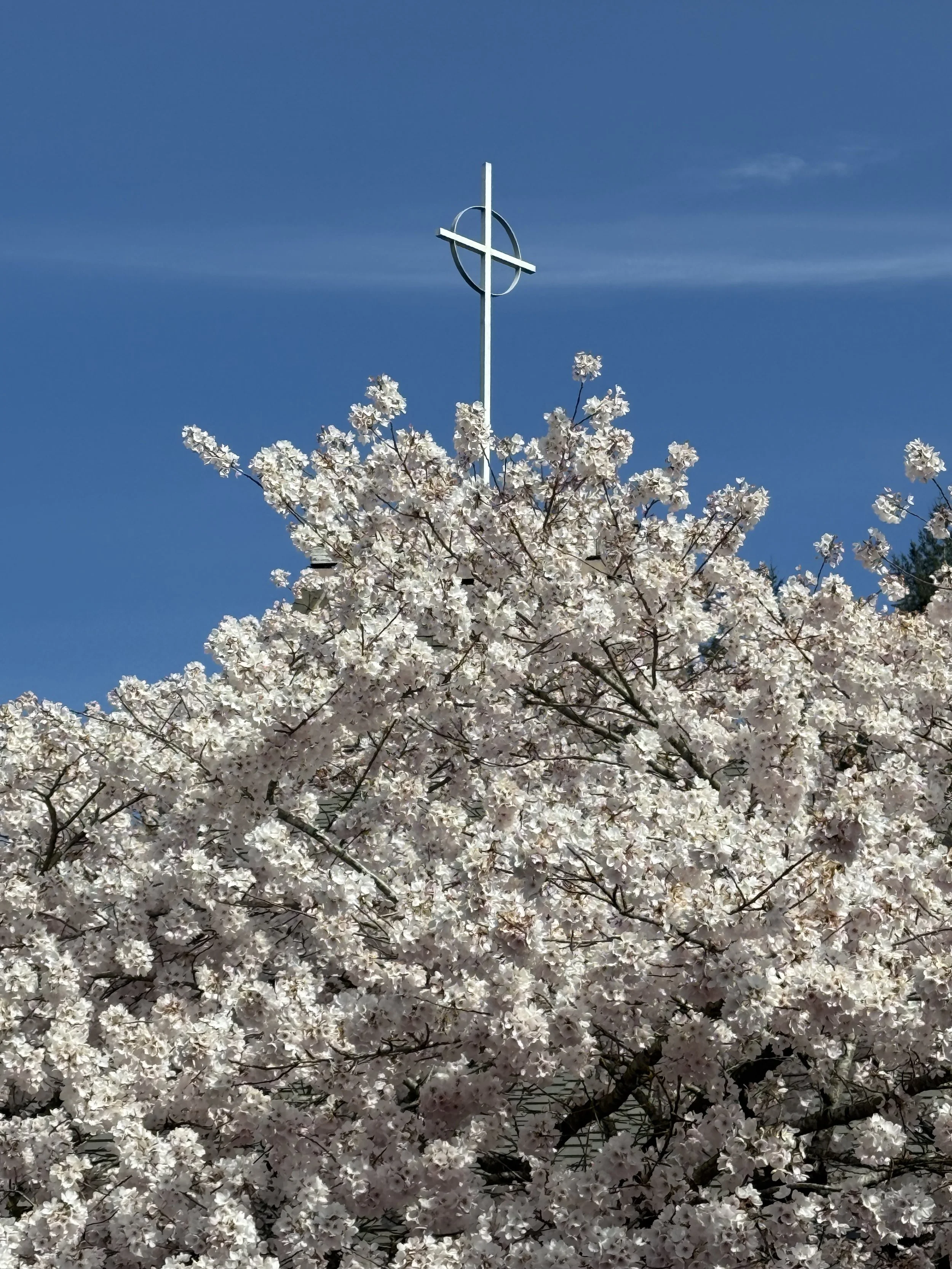
Resurrection is Happening
Unrelenting resurrection. Not just for Jesus, for everyone. We’re stirred by a force willing to overcome our frozen resolve.
Resurrection. When I was growing up, I learned this happened once upon a time in a village far, far away. What I know now is that this extraordinary event is happening. Particularly, in the common everyday workings of our psyche.
The story of Easter has captured me again. It’s a story I see in many places, most easily in the natural world of fallen trees offering life abundant through their death.
Can it be that common? Can something of Biblical proportions be infused within the ordinary? I hope so. I need that story so very much in order to live a bold love today, for my family, my neighbors and the world.
I catch glimpses of this life-through-death pattern in great stories told. My family watched Narnia again this weekend and I returned to this story, the realm of the never-Christmas-always-winter with hopes of believing again in a promise persistent through and greater than crushing, dominating forces.
In my work with clients, I see this pattern play out as we follow a difficult healing path that requires a descent into the stories of life, many of us would rather not face. Yet again and again this way proves faithful, opening up worlds of understanding and emotional freedom locked away behind walls of intelligent resistance.
As people struggle with their lives, wrestling to keep their adaptations in place and avoid pain and suffering, a quiet ache echoes within. A life wanting to be lived, even behind the fortified defense, something stirs the heart, a muffled resurrection.
If adaptations and defenses worked entirely, then the call from our hearts might just die, and there would be a type of rest. Instead, in our avoidance, we live disturbed and dissatisfied.
Why?
Unrelenting resurrection. Not just for Jesus, for everyone. We’re stirred by a force willing to overcome our frozen resolve.
The problem with burying our hearts behind walls is that they still cry out, disturbing our neat and tidy order. Our attempt to control the wild ways of our hearts leads to a deep emptiness that our integrity can not bear, and we are thus discontent.
Little by little as we listen to this disturbance, we can hear a truth emerge that we’re hungry for much more than our adaptations will acknowledge.
As we lower our defenses, practicing an acceptance and open posture to suffering, we allow the natural expanse of our hearts to live. Like Aslan breathing on stone statues, we’re brought back to life. Where indifference and rage have built up walls, tender compassion erodes the foundations built, unearthing a buried desire for fullness of capacity and range.
This is new life. This is resurrection.
Almost to our dismay, resurrection is happening. This persistent life force, this love hunger, aching to make things new, ruins so many living controlled, concealed, and contented lives. The world is aching for a bold love, all of creation is groaning, and with the promise of Easter, life will never quit.

Welcoming the Visitors
Paying attention to our voice and working with our voice allows for a subtle and vital shift. We can unlearn patterns of inhospitability by opening up a welcoming pathway. Our voice can offer that pathway.
As we develop, we learn to stand at the threshold of our emotions and determine which will pass into the home of our being and which will not. We learn to be the doorkeeper, hospitable to the attractive guests and turning away the unwanted, and in so doing, narrow the passageway to our interior emotional life.
When we grow up with messages saying certain feelings are welcome and others are not, we become inhospitable to the range of emotions. We learn to resist these emotions and constrict, leaving us closed and narrowed to the more difficult emotions present in our human experience.
We develop this way, given the messages we as men and women receive about how we should or shouldn’t feel. We learn to be in a combative relationship with “negative” emotions while over-emphasizing “valued” emotions. We emotionally constrict, closing here and opening there, learning to relate through emotions that are culturally acceptable.
We begin to limit ourselves, and we can hear this in our voice. In trying to control our feelings and ensure the most appropriate emotions are conveyed, we change our tone, volume, and even the personality of our voice. Actors know this avenue well and spend years developing their voice to be versatile for different roles and to convey subtle nuances. We have learned to adapt with different voices according to our posture of hospitality.
Control, however, is not something we can gain over our feelings and emotions, and when we try, we end up convincing ourselves of a reality that our minds believe, while our bodies keep signaling a different truth. The truth that shows up in moments of eruption, anxiety, or in a season of depression. These emotions emerge within marriages, towards kids, in close partnerships - revealing the difficult-to-face reality within.
Often, when I begin working with clients, they tell me something painful and I’ll ask them about their laughter, “Did you notice you laughed? Is there something funny?” They will say it’s not funny and they didn’t really mean to laugh. Their reaction (laughter) to their feelings is incongruent. They’ll often say, “I don’t know why I laughed.” The reactivity to their feelings has become barely conscious and out of alignment with their lived experience. In that moment, we’re given a window to a persona that has developed in relation to the unwelcome emotions.
Paying attention to our voice and working with our voice allows for a subtle and vital shift. We can unlearn patterns of inhospitability by opening up a welcoming pathway. Our voice can offer that pathway.
Clients will begin therapy at a crucial moment in their lives. Something is stirring beneath the surface that they can’t manage, or a relationship is no longer functioning. Among other things, we’ll engage in a mindful vocalizing practice. The emotions that have been unwelcome begin to find hospitality through this open passage. While it can be unnerving, and the unwelcome mat can return quickly, it also brings a welcome sense of relief and a new posture to practice.
Engaging the body through the breath and voice is a direct partnership with the reality that we are not in control, but we do have some power and choice. This breath that breathes in us can be partnered with, slowed down, made deeper and longer, given voice; we are not in control, this breath is breathing, these emotions are emoting, but we can participate and partner, becoming a hospitable host to the emotions that come to visit.

It’s hard to be a man
It’s so hard to be a man.
We’re told as men that we need to be hard. We as men often think the most manly thing to be is hard.
What I find for myself, my sons, my brothers, and the men I work with is that it’s so hard to be a man.
Most men I know really want to be a good man, husband, father, brother and friend to others. So often, the breakdown in these very relationships and the chief complaint from wives, partners, children, friends and family, is that men are emotionally unavailable or emotionally insensitive or emotionally volatile.
Typically, this is displayed in shutting down (freeze), pulling away (flight) and or blowing up and being aggressive (fight).
How did we get here? Why are we men this way?
There are so many intricate, layered messages about who we as men are supposed to be and how we’re supposed to feel and behave.
Be tough. Don’t cry. Try harder. Be harder. Be hard.
In reality, we’re so tender. It doesn’t take much to hurt us, and it doesn’t take much for our nervous system to overload and shut down. We scare really easily.
The truth is, we’re very sensitive. It’s evident in our anatomy. A simple knock across our nuts and we drop to the ground. It’s a plain and simple truth seen in every blooper reel: a little toddler swings a plastic bat into dad’s groin and down the big man goes.
This physical sensitivity is mirrored in the sensitivity of our self, our psyche and emotional structure. We’re so sensitive and we know it…and we often don’t know what to do with all that sensitivity! So we bury it, stuff it, try and be cool and “manly”.
Our sensitivity is a pivot point for humility or hardening. The same prompt, our sensitivity, can be the impetus for us to move towards tenderness and truth or towards hardness and hatred…hatred of self for being so sensitive. So we’re at odds with ourselves, making it hard to be ourselves.
It’s understandable why so many men learn and practice dismissing their own sensations, sensitivity and sensuality. Sure, it’s cool to be hard, but most of the time we’re soft, flaccid and just dangling out there with the potential of getting wacked. So much potential! However, we’ve often been given little to no guidance that helps us be the sensitive men that we be.
The flip side is, as we dismiss our sensitive selves, we begin to feel less than, we feel unfulfilled, empty, and not enough. Not big enough and strong enough and not making enough…the list goes on.
These two things are tied together: our sensitivity and not enough. Emptiness, a lack of fulfillment, this gnawing feeling of not being enough, and the dismissiveness of sensitivity. This makes it very very hard to be a man.
We men are desperate for a change. So let’s get to work in a way that doesn’t make it any more difficult to be ourselves.
We need to shift our awareness to understand the belief systems we grew up in that impact, shape and inform what we believe about ourselves as men.
We need simple practices that shift our awareness to our sensations and emotions - emotions which we experience through our sensations.
We need to do this with others, to normalize our sensitivity, which has been socially and culturally ridiculed.
We know as men that we’re sensitive. Acknowledging our deep sensitivities with kindness will humble us into our integrity and the truth of our tender selves.

Not Enough
Often, men will say they aren’t enough. They aren’t doing enough, they aren’t making enough, they aren’t smart enough, fast enough, strong enough, rich enough, handsome enough.
They aren’t a good enough father, husband, son, employee, or friend.
Recently, a client of mine was going to do nothing intentionally for an afternoon…he worried he wouldn’t do enough of nothing. We were able to have a good laugh there, because once you begin to track the pattern and the underlying message of “you’re not enough”, it’s actually absurd.
But when you’re caught up in it…
It’s a living hell.
Caught up in the never-ending cycle of never being enough.
Enjoyment and satisfaction are fleeting.
Rest and relaxation are few and far between.
And there’s data all day long to reinforce the point that you are not enough. Compare yourself to this, that, him or her and you’re left feeling like you’re not enough.
Sometimes, even the dog or cat has it better.
Most men are enraged by this cycle. You give it everything you’ve got and still, you aren’t enough, it isn’t enough, they aren’t happy enough, nothing is enough.
There’s never enough sex, money, or power.
And “you’re not enough” is about more than just penis size.
There’s compensation everywhere in your life because of a shortfall. Not outside of you, in what you earn through your bank account or social status, but internally. A void, that when ignored grows as though begging for attention, and our impoverished culture can only feed the void junk that doesn’t satisfy and counsel that lacks wisdom.
If you’re sick and tired of the same damn loop and you’re ready for a course correction, my course work will help you. Here’s why I can help.
I’ve struggled.
I struggle.
I’ll struggle more.
But not like I used to. I used to run and hide. And I’m doing that less and less.
And more and more I’m finding depths of connection, intimacy, laughter, tears, courage, and playfulness that I’ve wanted my whole life.
Because, less and less I fight against my own emotional experience and more and more I’m wholeheartedly accepting the variety of life’s difficult offerings.
And I want to share with you what I’ve learned from my life, my own healing journey, my clinical experiences, and my education.
I’ve seen men as clients for over 15 years, and I know this to be true - we men need a lot of help. A lot. And it can be really, really difficult for us to ask for help.
My course, carefully crafted over time, has the potential to kick your ass in a new direction…with a rather welcoming, understanding approach.
I’ve zeroed in on the core elements needed for change, focusing on the most common trigger points and motivations important to men.
You want your life to work, your relationships to function and thrive, you want to be connected and feel alive and at ease with yourself and others.
I can help you get there.
Reach out today. Let’s get you moving in the right direction before you lose out on another day, week, month, or year cycling through the same old shitty patterns.
Let’s get to work, working for you.